Benchmarking antimicrobial peptides#
In this notebook, we use seqme to evaluate antimicrobial peptide sequences.
%load_ext autoreload
%autoreload 2

from pathlib import Path

import matplotlib.pyplot as plt
import numpy as np
import seaborn as sns
import torch

import seqme as sm
device = "cuda" if torch.cuda.is_available() else "cpu"
Data#
Let’s load the datasets.
BASE_PATH = Path("./docs/tutorials")

DATASET_PATHS = {
    # Databases
    "UniProt": BASE_PATH / "data/dbs/uniprot/uniprot_8_50_100.fasta",
    "AMP-data": BASE_PATH / "data/dbs/amps.fasta",
    "AMPs": BASE_PATH / "data/dbs/amps_hq.fasta",
    "DBAASP": BASE_PATH / "data/dbs/dbaasp.fasta",
    # Models
    # "AMP-Cao": BASE_PATH / "data/models/amp_cao.fasta", # has "X"
    "AMP-translstm": BASE_PATH / "data/models/amp_translstm.fasta",
    "AMP-Diffusion": BASE_PATH / "data/models/amp-diffusion.fasta",
    "AMP-GAN": BASE_PATH / "data/models/amp-gan.fasta",
    "AMP-GAN2": BASE_PATH / "data/models/ampgan10k.fasta",
    "CPL-Diff": BASE_PATH / "data/models/cpl-diff.fasta",
    "HydrAMP": BASE_PATH / "data/models/hydramp.fasta",
    "Hyformer": BASE_PATH / "data/models/hyf_seq.fasta",
    # "mlpeptide": BASE_PATH / "data/models/mlpeptide10k.fasta", # some are lower case
    "MMCD": BASE_PATH / "data/models/MMCD.fasta",
    "CVAE": BASE_PATH / "data/models/unconstrained_cvae_basic_sequences.fasta",
    "PepCVAE": BASE_PATH / "data/models/unconstrained_pepcvae_sequences.fasta",
    # "Zeng et. al.": BASE_PATH / "data/models/zeng.fasta", # has "X"
    "OmegAMP": BASE_PATH / "data/models/omegamp/unconditional.fasta",
    "OmegAMP (prop.)": BASE_PATH / "data/models/omegamp/property-conditional.fasta",
    "OmegAMP (subset)": BASE_PATH / "data/models/omegamp/subset-hq-conditional.fasta",
    #
}
datasets = {name: sm.read_fasta(path) for name, path in DATASET_PATHS.items()}
for model_name, sequences in datasets.items():
    print(f"{model_name}: {len(sequences)} sequences")
UniProt: 2933310 sequences
AMP-data: 38473 sequences
AMPs: 7204 sequences
DBAASP: 8967 sequences
AMP-translstm: 36003 sequences
AMP-Diffusion: 47671 sequences
AMP-GAN: 150000 sequences
AMP-GAN2: 5008 sequences
CPL-Diff: 49985 sequences
HydrAMP: 50000 sequences
Hyformer: 50000 sequences
MMCD: 18890 sequences
CVAE: 50000 sequences
PepCVAE: 50000 sequences
OmegAMP: 149504 sequences
OmegAMP (prop.): 50000 sequences
OmegAMP (subset): 49152 sequences
AMINO_ACID_LETTERS = list("ACDEFGHIKLMNPQRSTVWY")
AMINO_ACID_SET = set(AMINO_ACID_LETTERS)


def verify(sequence: str):
    invalid = set(sequence) - AMINO_ACID_SET
    if invalid:
        raise ValueError(f"Invalid amino acid(s): {', '.join(sorted(invalid))}")


for model_name, sequences in datasets.items():
    print(f"Parsing '{model_name}'")
    for sequence in sequences:
        verify(sequence)
Parsing UniProt
Parsing AMP-data
Parsing AMPs
Parsing DBAASP
Parsing AMP-translstm
Parsing AMP-Diffusion
Parsing AMP-GAN
Parsing AMP-GAN2
Parsing CPL-Diff
Parsing HydrAMP
Parsing Hyformer
Parsing MMCD
Parsing CVAE
Parsing PepCVAE
Parsing OmegAMP
Parsing OmegAMP (prop.)
Parsing OmegAMP (subset)
Let’s setup the data and models.
sources = list(DATASET_PATHS.keys())

n_samples = 3_000  # 40_000  # 3_000
seed = 42

benchmark_datasets = {
    source: sm.utils.subsample(datasets[source], n_samples=n_samples, seed=seed)
    if len(datasets[source]) > n_samples
    else datasets[source]
    for source in sources
}
# benchmark_datasets["DBAASP (shuffled)"] = sm.utils.shuffle_characters(datasets["DBAASP"], seed=seed)
benchmark_datasets["AMP-data (permuted)"] = sm.utils.shuffle_characters(benchmark_datasets["AMP-data"], seed=42)

seqs_uniprot = datasets["UniProt"]
seqs_amps = datasets["AMPs"]
seqs_train = datasets["AMP-data"]
Models#
Let’s load the models and set up the cache.
CACHE_PATH = "new_cache.pkl"

init_cache = sm.read_pickle(CACHE_PATH) if CACHE_PATH else None
Let’s setup the third-party models.
Let’s setup AMPlify.
# !conda create -n amplify_env python=3.9 -y
amplify = sm.models.ThirdPartyModel(
    entry_point="predict:predict",
    repo_path="../plugins/thirdparty/amplify",
    # python_bin="/opt/anaconda3/envs/amplify_env/bin/python",
    python_bin="/home/icb/rasmus.larsen/tools/apps/miniconda3/envs/amplify_env/bin/python",
    repo_url="https://github.com/szczurek-lab/seqme-thirdparty",
    branch="amplify",
)
Let’s setup amPEPpy.
# !conda create -n ampeppy_env python=3.8 -y
ampeppy = sm.models.ThirdPartyModel(
    entry_point="amPEPpy.predict:predict",
    repo_path="../plugins/thirdparty/ampep",
    # python_bin="/opt/anaconda3/envs/ampep_env/bin/python",
    python_bin="/home/icb/rasmus.larsen/tools/apps/miniconda3/envs/ampeppy_env/bin/python",
    repo_url="https://github.com/szczurek-lab/seqme-thirdparty",
    branch="ampeppy",
)
Let’s setup the cache.
def my_embedder(sequences: list[str]) -> np.ndarray:
    lengths = [len(sequence) for sequence in sequences]
    counts = [sequence.count("K") for sequence in sequences]
    return np.array([lengths, counts]).T


esm2 = sm.models.ESM2(
    model_name=sm.models.ESM2Checkpoint.t6_8M,
    batch_size=512,
    device=device,
    verbose=False,
)

cache = sm.Cache(
    models={
        "embedder": my_embedder,
        "esm2-embed": esm2.embed,
        "esm2-perplexity": lambda seqs: esm2.compute_pseudo_perplexity(seqs, mask_size=3),
        "gravy": sm.models.Gravy(),
        "charge": sm.models.Charge(),
        "amphiphilicity": sm.models.HydrophobicMoment(),
        "amPEPpy": ampeppy,
        "AMPlify": amplify,
    },
    init_cache=init_cache,
)
Plotting#
Let’s look at the embeddings of the embedding model.
datasets_to_plot_names = ["UniProt", "AMP-data"]
# @TODO: include shuffled AMP-data?

colors = ["#d66868", "#68d6bc"]

n_samples = 30_000
seed = 42

datasets_to_plot = {
    name: sm.utils.subsample(datasets[name], n_samples=n_samples, seed=seed)
    if len(sequences) > n_samples
    else datasets[name]
    for name in datasets_to_plot_names
}
embedder_name = "esm2-embed"
embedder = cache.model(embedder_name)

embeddings = {name: embedder(dataset) for name, dataset in datasets_to_plot.items()}
uniprot = sm.utils.subsample(datasets["UniProt"], n_samples=30_000, seed=42)
charge_fn = cache.model("charge")
amphiphilicity_fn = cache.model("amphiphilicity")

uniprot_charge = charge_fn(uniprot)
uniprot_amphiphilicity = amphiphilicity_fn(uniprot)

amp_data_charge = charge_fn(seqs_amps)
amp_data_amphiphilicity = amphiphilicity_fn(seqs_amps)
xs_tsne = sm.utils.tsne(list(embeddings.values()))
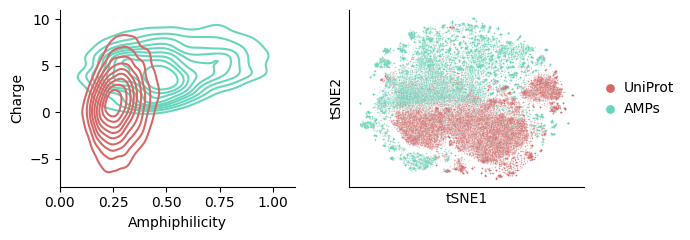
Using “Silverman” to estimate the kde bandwidth appears to work well here. Also notice AMPs usually have a positive charge.
Metrics#
Let’s select the metrics.
embedder = "esm2-embed"  # "embedder"


metrics = [
    sm.metrics.Count(),
    sm.metrics.Uniqueness(),
    sm.metrics.Diversity(k=5, name="Diversity (5)"),
    sm.metrics.Novelty(reference=seqs_train),
    sm.metrics.FKEA(embedder=cache.model(embedder), bandwidth=1.0, strict=False),
    sm.metrics.FBD(reference=seqs_uniprot, embedder=cache.model(embedder), name="FBD (UniProt)"),
    # sm.metrics.MMD(reference=seqs_uniprot, embedder=cache.model(embedder), name="MMD (UniProt)"),
    sm.metrics.FBD(reference=seqs_amps, embedder=cache.model(embedder)),
    # sm.metrics.MMD(reference=seqs_amps, embedder=cache.model(embedder)),
    # sm.metrics.Fold(
    #    sm.metrics.Precision(
    #        n_neighbors=3, reference=seqs_train, embedder=cache.model(embedder), strict=True, device=device
    #    ),
    #    split_size=len(seqs_train),
    #    drop_last=True,
    # ),
    # sm.metrics.Fold(
    #    sm.metrics.Recall(
    #        n_neighbors=3, reference=seqs_train, embedder=cache.model(embedder), strict=True, device=device
    #    ),
    #    split_size=len(seqs_train),
    #    drop_last=True,
    # ),
    # ID(predictor=cache.model("hyformer-perplexity"), name="Perplexity", objective="minimize"),
    # sm.metrics.ID(predictor=cache.model("AMPlify"), name="AMPlify", objective="maximize"),
    sm.metrics.ID(predictor=cache.model("amPEPpy"), name="amPEPpy", objective="maximize"),
    sm.metrics.AuthPct(train_set=seqs_train, embedder=cache.model(embedder)),
    sm.metrics.ConformityScore(
        reference=seqs_amps,
        predictors=[cache.model("amphiphilicity"), cache.model("charge")],
        kde_bandwidth="silverman",
    ),
]
Fold computes the metrics multiple using different folds, and aggregate the values (mean and standard deviation).
Wrapping Fold around the Precision and Recall metric, removes the sample size bias inherent in these metrics (introduced by k-NN), while still utilizing as many of the available sequences as possible.
Table#
Let’s compute the metrics for each group of sequences.
df = sm.evaluate(benchmark_datasets, metrics)
100%|██████████| 180/180 [08:34<00:00, 2.86s/it, data=AMP-data (permuted), metric=Conformity score]
OUT_CACHE_PATH = "new_cache.pkl"

sm.to_pickle(cache.get(), OUT_CACHE_PATH)
Let’s look at the results.
sm.show(df, color_style="bar")
| Count↑ | Uniqueness↑ | Diversity (5)↑ | Novelty↑ | FKEA↑ | FBD (UniProt)↓ | FBD↓ | amPEPpy↑ | Authenticity↑ | Conformity score↑ | |
|---|---|---|---|---|---|---|---|---|---|---|
| UniProt | 3000.00 | 1.00 | 0.84 | 1.00 | 266.13 | 0.06 | 5.50 | 0.60±0.14 | 0.83 | 0.25±0.00 |
| AMP-data | 3000.00 | 1.00 | 0.86 | 0.00 | 339.65 | 2.97 | 1.33 | 0.62±0.21 | 0.00 | 0.37±0.00 |
| AMPs | 3000.00 | 1.00 | 0.82 | 0.00 | 359.85 | 5.53 | 0.02 | 0.76±0.15 | 0.00 | 0.51±0.00 |
| DBAASP | 3000.00 | 0.99 | 0.85 | 0.10 | 360.99 | 3.45 | 0.74 | 0.67±0.21 | 0.09 | 0.41±0.00 |
| AMP-translstm | 3000.00 | 1.00 | 0.82 | 1.00 | 30.65 | 2.25 | 8.88 | 0.53±0.38 | 0.96 | 0.09±0.00 |
| AMP-Diffusion | 3000.00 | 0.97 | 0.82 | 1.00 | 344.12 | 2.80 | 2.30 | 0.35±0.22 | 0.89 | 0.35±0.00 |
| AMP-GAN | 3000.00 | 1.00 | 0.81 | 1.00 | 123.37 | 2.74 | 5.04 | 0.48±0.22 | 0.82 | 0.44±0.00 |
| AMP-GAN2 | 3000.00 | 1.00 | 0.79 | 1.00 | 169.74 | 3.69 | 3.88 | 0.63±0.15 | 0.84 | 0.52±0.00 |
| CPL-Diff | 3000.00 | 0.99 | 0.83 | 0.99 | 398.80 | 6.47 | 0.71 | 0.70±0.16 | 0.87 | 0.42±0.00 |
| HydrAMP | 3000.00 | 1.00 | 0.86 | 1.00 | 380.39 | 6.51 | 4.72 | 0.52±0.15 | 0.91 | 0.32±0.00 |
| Hyformer | 3000.00 | 0.76 | 0.80 | 0.75 | 139.88 | 6.38 | 0.68 | 0.76±0.15 | 0.60 | 0.45±0.00 |
| MMCD | 3000.00 | 1.00 | 0.81 | 1.00 | 180.65 | 2.27 | 5.49 | 0.52±0.16 | 0.83 | 0.38±0.00 |
| CVAE | 3000.00 | 1.00 | 0.87 | 1.00 | 236.22 | 2.66 | 4.97 | 0.48±0.16 | 0.87 | 0.32±0.00 |
| PepCVAE | 3000.00 | 1.00 | 0.87 | 1.00 | 225.91 | 2.57 | 4.81 | 0.52±0.15 | 0.87 | 0.34±0.00 |
| OmegAMP | 3000.00 | 0.98 | 0.86 | 0.92 | 324.41 | 3.10 | 2.33 | 0.59±0.20 | 0.76 | 0.39±0.00 |
| OmegAMP (prop.) | 3000.00 | 1.00 | 0.80 | 0.98 | 356.98 | 4.86 | 1.37 | 0.71±0.17 | 0.84 | 0.52±0.00 |
| OmegAMP (subset) | 3000.00 | 0.98 | 0.83 | 0.92 | 345.49 | 4.01 | 0.71 | 0.69±0.17 | 0.77 | 0.51±0.00 |
| AMP-data (permuted) | 3000.00 | 1.00 | 0.86 | 1.00 | 312.45 | 2.97 | 2.84 | 0.58±0.17 | 0.59 | 0.37±0.00 |
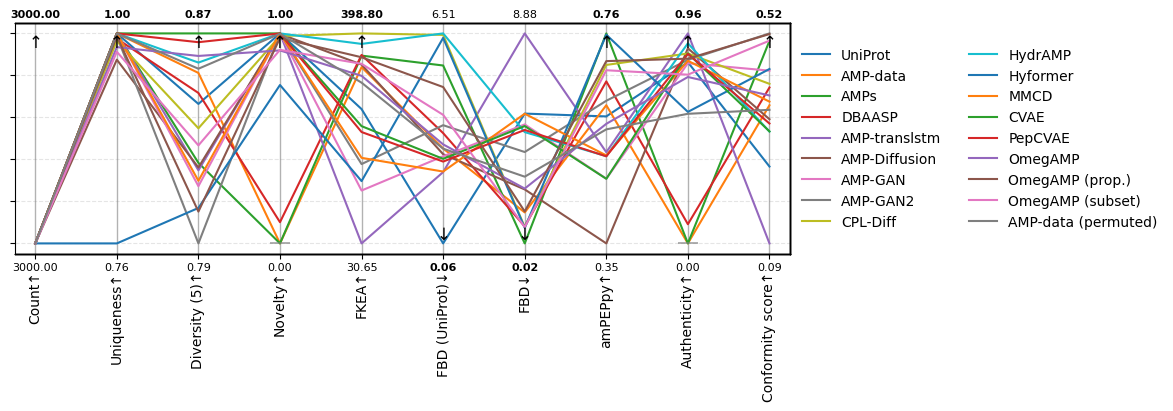
sm.plot_parallel(df, arrow_size=12, figsize=(10, 3))
Post analysis.
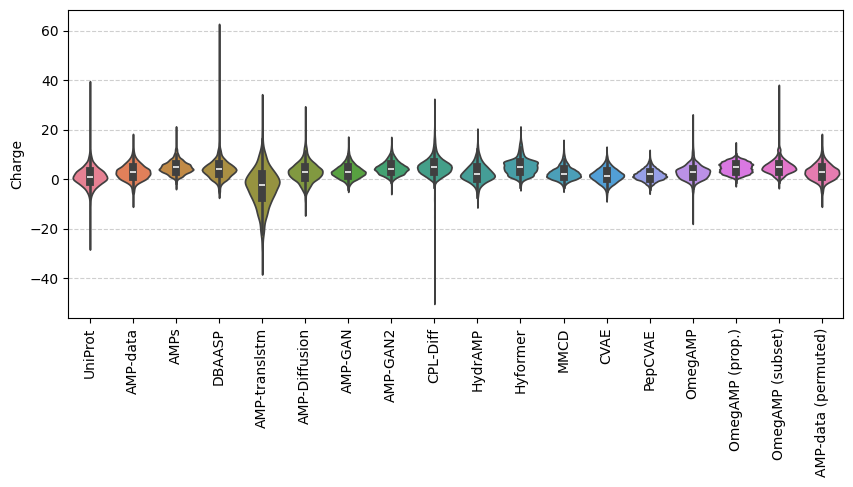
properties = {name: cache.model("charge")(sequences) for name, sequences in benchmark_datasets.items()}
fig, ax = plt.subplots(figsize=(10, 4))
ax.grid(axis="y", linestyle="--", alpha=0.6)
ax.set_axisbelow(True)
ax.set_ylabel("Charge")
ax.set_xticklabels(properties.keys(), rotation=90, ha="center")
sns.violinplot(properties, bw_method="scott", ax=ax)
/localscratch/ipykernel_2515221/1180707910.py:5: UserWarning: set_ticklabels() should only be used with a fixed number of ticks, i.e. after set_ticks() or using a FixedLocator.
  ax.set_xticklabels(properties.keys(), rotation=90, ha="center")
<Axes: ylabel='Charge'>
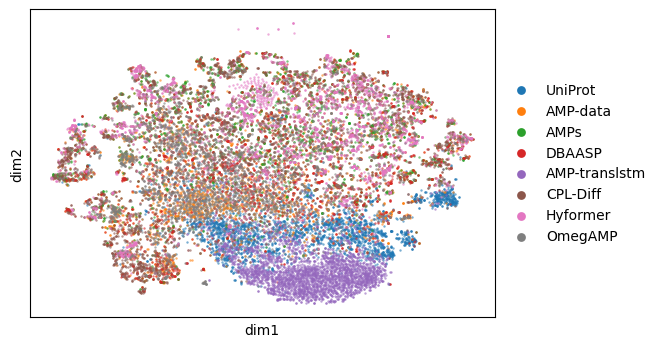
sources = ["UniProt", "AMP-data", "AMPs", "DBAASP", "AMP-translstm", "CPL-Diff", "Hyformer", "OmegAMP"]

embeddings = {source: cache.model(embedder)(benchmark_datasets[source]) for source in sources}

embedding_names = list(embeddings.keys())
embedding_values = list(embeddings.values())
proj = sm.utils.tsne(embedding_values)
proj = dict(zip(embedding_names, proj, strict=True))
sm.utils.plot_embeddings(
    proj.values(),
    values=proj.keys(),
    xlabel="dim1",
    ylabel="dim2",
    point_size=3,
    legend_point_size=40,
    figsize=(6, 4),
)